
The ROAD to Housing in Wisconsin: Making the Most of the Federal Housing Bill

Recommended Reading:
The New Localism: Federalism in Motion: Implementation of the 21st Century ROAD to Housing Act
Institute for Progress (IFP): The Success of the New Federal Housing Law Now Rests on States and Localities
Pew: The Success of the New Federal Housing Law Now Rests on States and Localities
The Cap Times: New affordable housing law has something for ‘everybody,’ expert says
As the articles above articulate, the federal 21st Century ROAD to Housing Act (which became law on July 11, 2026) has numerous provisions designed to incentivize housing production, which requires state and local governments to change their statutes and ordinances to make the most of the law, and more importantly, produce more housing to address the national shortage!
This blog is wonkier than what I normally write. Below, I focus on what Wisconsin and local governments can or must do in some cases to make the most of the ROAD to Housing Act.
I have attempted to build upon the summaries mentioned above with the goal of further assisting our state and local governments and providing something local housing advocates can use to spur reform. The new incentives will typically be issued by the federal Department of Housing and Urban Development (HUD), but there are many changes to existing programs like CDBG, HOME, and Section 8. The information contained here (and in the links above) is by no means an exhaustive analysis of the ROAD to Housing Act, but my attempt to make sense of the Bill from a Wisconsin-based perspective.
For the Wisconsin State Government
Section 102 – “Federal Guidelines for Point-Access Block Buildings”
(Single-Stair Apartment Buildings)
Congress authorized HUD in this section to award competitive grants to state and local governments “to implement pilot projects that evaluate, demonstrate, or validate the safety, feasibility, or cost-effectiveness of point-access block residential buildings.” There will be money for the state of Wisconsin or local governments to facilitate these pilot projects.

Section 301 – “Housing Supply Expansion Act”
(Certify parity for manufactured housing)
Manufactured housing is most closely associated with mobile home communities, also known as trailer parks. However, the factory-built home industry has progressed to the point where it can manufacture entire homes or sections of homes (modules) for assembly on site, which are not distinguishable from homes built with traditional methods. These factory-built homes, once placed on a foundation, cannot be moved again without the same degree of difficulty as moving a home built on-site with traditional methods. Manufactured or prefabricated housing can be priced competitively with homes built on-site, as efficiency in construction occurs in a controlled factory environment.
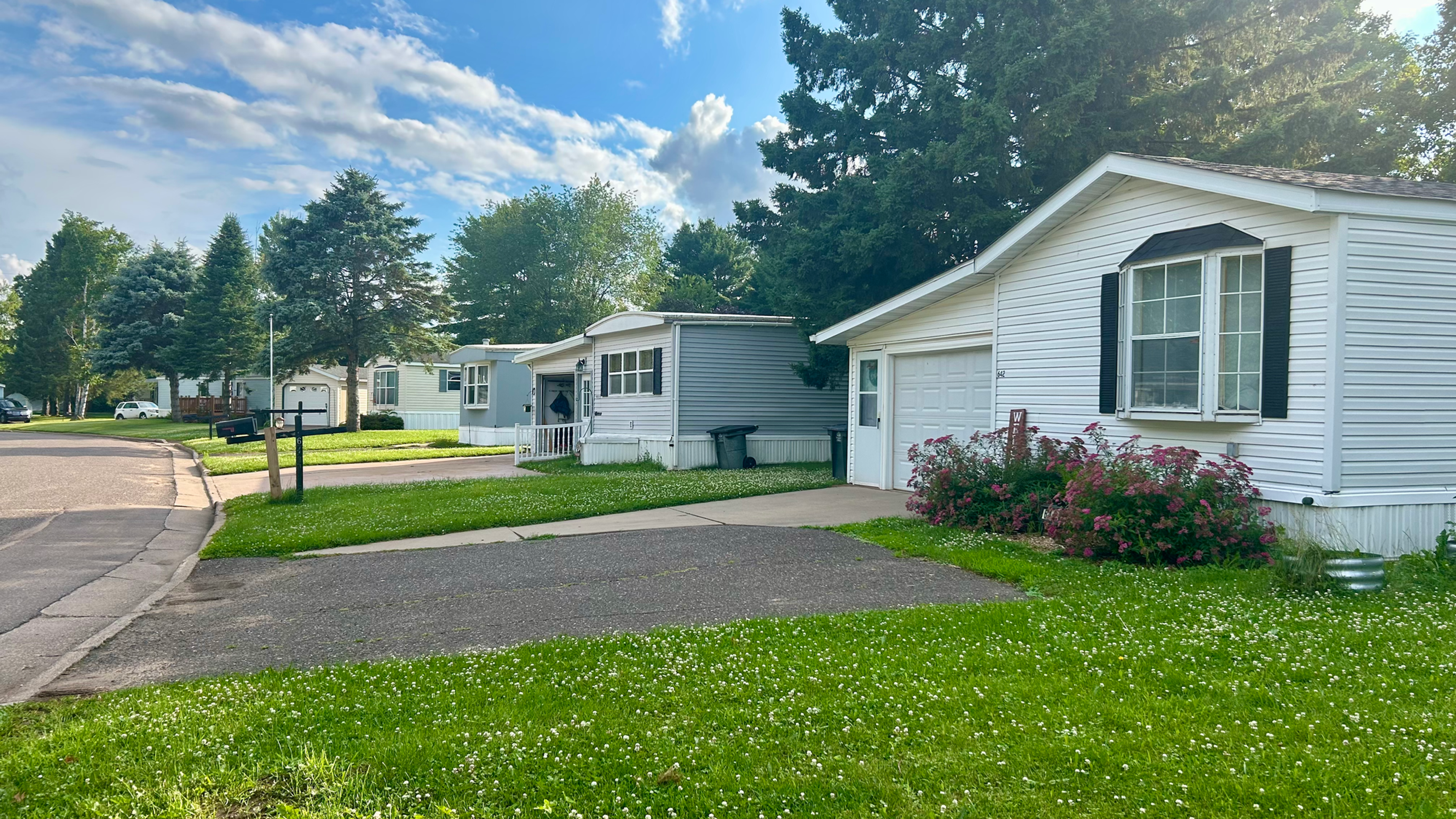
Congress recognizes in the ROAD to Housing Act that new factory-built housing does not solely consist of the mobile homes or “trailers” of yesteryear–and has updated the federal statutes to reflect that. The states are now tasked under the Act to bring their statutes in line with federal regulations.
Further, states may wish to incentivize or compel local zoning authorities to allow greater flexibility in their zoning codes as existing restrictions are based on outmoded negative stereotypes of trailer parks.

Upon initial review, it appears that Wisconsin’s statutes and administrative codes generally default to federal regulations and definitions, but discrepancies may exist as outlined below.
Under Section 301 of the Act, the state of Wisconsin has one year from the enactment of the ROAD to Housing Act (11 July 2027) to certify that all of the state’s laws and regulations “treat any manufactured home in parity with a manufactured home (as defined and regulated by the State)” (see more detail below).

If Wisconsin fails to comply with the regulation, it “shall prohibit the manufacture, installation, or sale of a covered manufactured home within [it]” (Section 301(c)(i)(5)(B)).

Right now, there may be discrepancies in the Wisconsin statutes and administrative code regarding manufactured homes, with some updates needed.
For example, Wis. Stat. § 101.91(2) defines a “Manufactured home” as "A structure that is designed to be used as a dwelling with or without a permanent foundation, and that is certified by the Federal Department of Housing and Urban Development (HUD) as complying with the standards established under 42 USC 5401 to 5425." The ROAD to Housing Act repealed 42 USC 5425.
The following regulations refer to manufactured homes being built on a permanent chassis, which implies manufactured homes are solely mobile homes or “trailers”:
Other than the examples outlined here, there may be other parts of Wisconsin’s statutes and administrative code that may require updating.
For Local Governments
Parity for Factory-Built Housing
The ROAD to Housing Act tasks states with establishing parity between factory-built housing and traditional housing built on-site. It may behoove local zoning authorities to update their zoning ordinances to establish parity as well, as much factory-built housing, once placed on-site, is indistinguishable from homes built on-site. In other words, today’s manufactured homes are not the mobile homes or “trailers” of the past.
Manufactured housing is most closely associated with mobile home communities, also known as trailer parks. However, the factory-built home industry has progressed to the point where it can manufacture entire homes or sections of homes (modules) for assembly on site, which are not distinguishable from homes built with traditional methods. These factory-built homes, once placed on a foundation, cannot be moved again without the same degree of difficulty as moving a home built on-site with traditional methods. Manufactured or prefabricated housing can be priced competitively with homes built on-site, as efficiency in construction occurs in a controlled factory environment.
See the PDF below for more information on today’s factory-built homes.

Amendments to the CDBG & HOME Programs
Wisconsin CDBG & HOME Recipients
Appleton
Beloit
Dane County*
Eau Claire*
Fond du Lac
Green Bay
Janesville
Jefferson County**
Kenosha*
La Crosse*
Madison*
Milwaukee*
Milwaukee County*
Neenah
Oshkosh
Ozaukee County**
Racine*
Rock County**
Sheboygan
Superior
Waukesha County*
Washington County**
Wausau
West Allis
*HOME Recipient
**HOME Recipient Only
Section 104 – CDBG Recipients MUST create a public database of publicly owned land
CDBG funds can be used to help create said public database.
Section 204 – “Addition of Affordable Housing Construction as an Eligible Activity”
CDBG dollars may be used for affordable housing rehabilitation AND construction.
Section 213 – “Build Now Act” (Carrot/Stick Incentives for New Homes in Expensive Places)
Federal CDBG appropriations may increase or decrease for those communities which respectively do, or do not, adequately grow their housing stock.
Section 501 – “Home Investment Partnerships Reauthorization and Reform Act” (Reforming the HOME Program)
Among other things, communities that don’t receive CDBG funds may use HOME dollars toward housing affordability up to 100 percent AMI, including community land trusts and housing cooperatives.

Grants for Local Governments
Section 102 – “Federal Guidelines for Point-Access Block Buildings”
(Single-Stair Apartment Buildings)
Congress authorized HUD in this section to award competitive grants to state and local governments “to implement pilot projects that evaluate, demonstrate, or validate the safety, feasibility, or cost-effectiveness of point-access block residential buildings.” There will be money for the state of Wisconsin or local governments to facilitate these pilot projects.
Section 201 – “Increasing Housing in Opportunity Zones”

Where are Opportunity Zones in Wisconsin? Look here to find out!

Section 202 – “Whole-Home Repairs Act” (Home repair grants)

Creates a pilot program for state and local governments directly or under contract with a qualified nonprofit, to issue home repair grants and loans to eligible homeowners and landlords.
Eligible homeowners will typically be at or below 80 percent AMI, while an eligible landlord will typically be an owner-occupant, own fewer than 10 rental properties with no more than 25 units, and include affordable units, among other criteria
Section 208 – “Innovation Fund” (Encourage Land Use & Regulatory Reform)
A competitive HUD grant for local governments that do the following:

Congress authorized HUD to issue grants ranging from $250,000 to $10 million with priority specified for those local governments or Indian tribes which show either “a marked improvement in housing supply growth” or have “demonstrated the use of innovative policies, interventions, or programs for increasing housing supply”.
Section 209 – “Accelerating Home Building Act” (Pre-Approved Building Plans)
Subject to Congressional appropriation, HUD must provide grants assisting local governments in developing pre-approved building plans. When states and/or communities have pre-approved building plans, a significant step in the development process would be bypassed.
Normally, if one wants to build a house, an applicant applies for a building permit, which first undergoes zoning review prior to plan review. Either a planner or zoning technician reviews the building proposal to ensure it meets the local zoning requirements. Upon zoning approval, the proposal goes to plan review, where the building plans are inspected to ensure the building code is met. With pre-approved building plans, plan review is bypassed entirely, potentially saving weeks or months from a development timeline.
A non-exhaustive list of places with pre-approved plans:
State of Michigan
State of Ohio
State of Oregon
State of Vermont
South Bend, Ind.

Section 212 – “Rental Assistance Demonstration Program” (A Program Expansion)
This section permanently reauthorizes the Rental Assistance Demonstration (RAD) program, which permits public housing authorities to rebuild existing public housing units. It also provides financing mechanisms to develop higher-quality apartments and mixed-income communities.
Section 304 – “Price Act” (Manufactured Home repair)
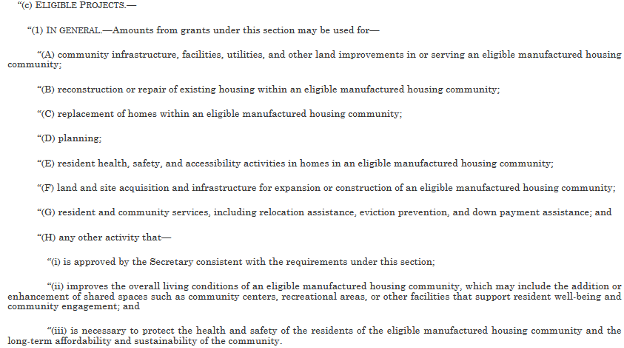
The PRICE grant program was reauthorized. It permits local governments, housing authorities, tribes, nonprofits, and resident-owned communities (HOAs) to fund repairs and upgrades to utilities and infrastructure for eligible projects in manufactured home communities.


Comments