
Mr. Smith Goes to Washington, So Our Communities Grow Smartly

Updated: Jul 8
By Ken Smith, Housing Policy Director
Frank Capra's Mr. Smith Goes to Washington Film Poster Ken Smith pictured in front of United States Capitol building, at the east end of the National Mall. Airport arrival in Washington D.C. View from the sky of the National Mall in Washington D.C.
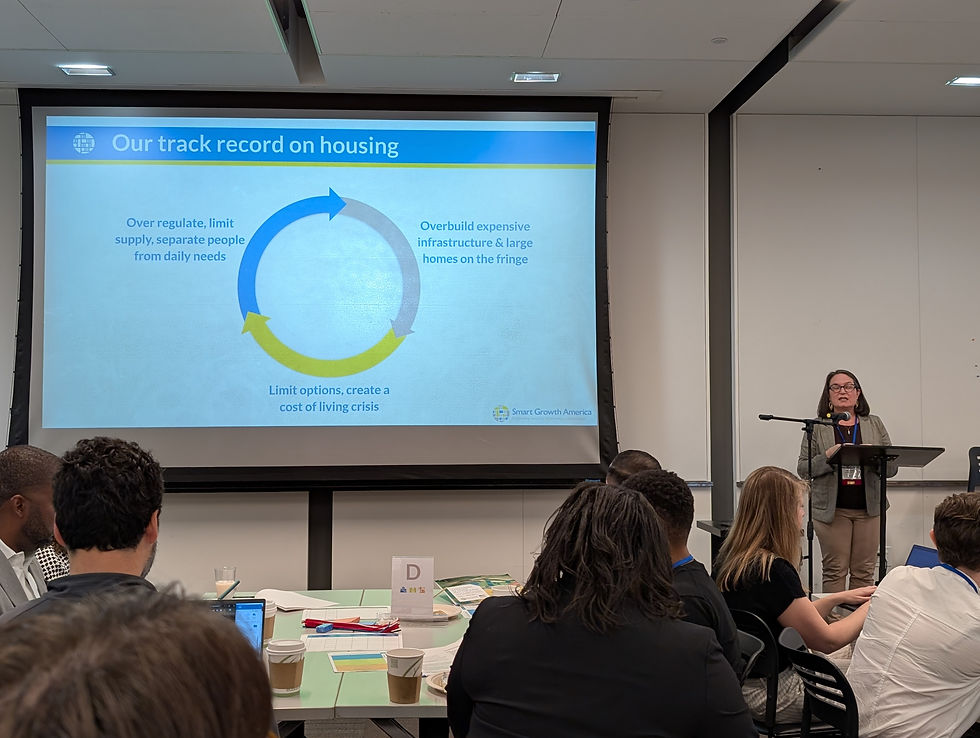
I flew to Washington, D.C., not as a senator like in the 1939 Frank Capra classic, but representing 1000 Friends and our great state at a meeting hosted by Smart Growth America to discuss “Zoning Solutions for Housing: Place, Type, and Price: Reforms to support community health, prosperity and resilience.” At the District Architecture Center on 7th Street NW and E Street NW, I networked with people from around the country. At my table were people from California, Rhode Island, and New York. We discussed housing solutions within the place, type, and price framework and what reforms are occurring at the federal and state levels.
Travel to D.C. featuring a plane, a train, and a bus!
Plane Trip Reading Material L'Enfant Plaza metro stop in Washington, D.C. Metro Bus Stop in College Park, Maryland.
The 2025 Smart Growth America blog post, Regulatory Reform: Solutions for type, place, price,” summarizes the flavor of our discussion, mainly that land use constraints common nationwide have exacerbated the housing shortage through limiting the supply of available housing and housing types at different price points. Specifically, overregulation at the local level through the municipal zoning power has limited the amount of new home construction and the lack of home variety in size and price. The vast majority of new homes brought online today are either large single-family homes on large lots of a half or full acre, or large multifamily developments consisting of residential towers or sprawling apartment complexes. It has been this way for decades and stems in large part from the overuse of Euclidean Zoning. Readers may recall that this year is the hundredth anniversary of the seminal 1926 U.S. Supreme Court case, Village of Euclid v. Ambler Realty Co.
Ken Smith collaborates with Smart Growth America housing conference attendees during the workshop. Smart Growth America housing conference in Washington, D.C., showing a full conference room Panel Speakers at Smart Growth America housing conference
In 1982, President Ronald Reagan’s Commission on Housing reported, “Euclid was controversial in its day and still has critics. Experience indicates that the broad land-use charter it afforded localities has been abused often at the expense of housing.” It further elaborated that, “Regulations limiting density prevent the market from responding to consumer demand. . .”, that “No limits (minimum or maximum) should be placed on the size of individual dwelling units. . .”, and “States and localities should remove from their zoning laws all forms of discrimination against manufactured housing. . .”
Looking back at my June Blog, one can see that in southeastern Wisconsin, for example, much of the seven-county region the Southeastern Wisconsin Regional Planning Commission (SEWRPC) encompasses, where people live, restricts the development of modest homes and/or the creation of modest lots. Further, density and/or apartment buildings are often prohibited across the region. The ability to build dense walkable places is restricted or prohibited across most of the region.



That is the primary reason why in 2023, walkable urban land in the largest 35 metropolitan areas was only 1.2 percent of total land mass. There is a clear undersupply in dense and walkable human habitat, despite the demand. That is a major reason why Madison’s Monroe Street, Atwood, and Willy Street neighborhoods, and Milwaukee’s East Side, Downtown, and Bay View neighborhoods are so expensive! Many people want to live in those places, or places like them, but they are illegal to build in most places – hence why they are so expensive!
However, this challenge is not unique to Madison and Milwaukee. Nationally, home prices are valued at five times the median income. In our state, the Wisconsin Policy Forum noted in March 2024, based on 2022 data, that Wisconsin home prices are outpacing incomes. More recent data show how prices have gotten worse for homebuyers. A May 2026 New York Times analysis based on data from Moody’s analytics found the following Metropolitan Statistical Areas to have the following price-to-income ratios based on a comparison of annual median household income compared with median home price. The rule of thumb is that homeowners shouldn’t buy more than 3x their annual household income, but the data shows that much of Wisconsin is increasingly unaffordable. Based on that study, Wisconsin Public Radio reports that homes in Wisconsin’s largest metros are among the least affordable in the Midwest.
Metropolitan Statistical Area (MSA) | Household Median Income to Median Home Price Ratio |
Milwaukee | 5.2 |
Madison | 5.0 |
Green Bay | 4.0 |
Racine | 3.9 |
Appleton | 3.8 |
Superior (Duluth, MN MSA) | 3.7 |
Sheboygan | 3.7 |
Eau Claire | 3.6 |
Janesville | 3.6 |
Kenosha | 3.5 |
La Crosse | 3.5 |
Fond du Lac | 3.4 |
Wausau | 3.3 |
In other words, for example, the median house in the Green Bay MSA costs four times (4x) the median household income in the Green Bay MSA. These data show that if households can afford their own homes, something increasingly less common, they are housing burdened or extremely housing burdened. Respectively, those households are paying more than 30 percent or 50 percent of their earnings toward housing.
What is to be done? Smart Growth America’s approach is to design policies by place, type, and price.

Local governments have it within their power right now to effectuate these policies to make it easier to build more housing and more housing types. Under basic supply and demand, the greater the housing supply available relative to demand, the lower the cost of housing. Further, when the only new houses that are being built are large homes on large lots, those larger homes on larger lots are naturally more expensive than a smaller “starter home” on a smaller lot. The difference in home size from ≤1,000 to 1,500 square feet versus 2,000 to 3,000 square feet of livable space creates a significant cost differential.
Beyond solutions oriented around place, type, and price, I learned at the meeting that despite our common nationwide housing shortage, the political palatability for different solutions varies considerably. As an example, accessory dwelling units (ADUs) are smaller structures, sometimes attached to the primary home, are alternatively known as backyard cottages, granny flats, or mother-in-law suites. I learned from Jordan Grimes of California's Greenbelt Alliance that ADUs have generally gained widespread acceptance in California. Yet leadership in the Wisconsin legislature did not allow relevant legislation to proceed to a vote despite 2025 Senate Bill 473 and 2025 Assembly Bill 449 receiving near-unanimous support in their respective committees. Further, unlike the flexibility allowed in California, the Wisconsin Assembly’s committee had amended the ADU bill to disallow ADUs from being detached from the primary home on a lot.

Conversely, every infill development in California until recently required a local environmental impact statement (EIS), which dramatically increased the cost and slowed the speed of new construction, whereas EIS studies are typically not required for infill developments across Wisconsin.
To learn more about these differences across states, Jacob Waggoner of New York University’s Furman Center presented an overview of its new Land Use Reform Tracker, which is available to the public! The data covers nationwide legislation from 2017 to 2024 on land use reform.
In 2027 and 2028, we hope to add to Wisconsin’s list! Let’s move housing onward in Wisconsin.
Exploring housing types in Washington, D.C.
Across much of southeastern Wisconsin, housing in dense, walkable places is restricted or prohibited. By contrast, the nation’s capital strongly embraces transit-oriented development. Enjoy some housing pictures from my walking tour of the city!
Exploring Housing Types in Washington D.C. Exploring Housing Types in Washington D.C. Exploring Housing Types in Washington D.C. Exploring Housing Types in Washington D.C. Exploring Housing Types in Washington D.C. Exploring Housing Types in Washington D.C. Exploring Housing Types in Washington D.C. Exploring Housing Types in Washington D.C. Exploring Housing Types in Washington D.C. Exploring Housing Types in Washington D.C. Exploring Housing Types in Washington D.C. Exploring Housing Types in Washington D.C. Exploring Housing Types in Washington D.C. Exploring Housing Types in Washington D.C. Exploring Housing Types in Washington D.C.


Comments